BassForecast: Fishing Forecast
- 4.4
- Rating
- 500.00K
- Installs
- Free
- Price
 Analysis by App-foxy
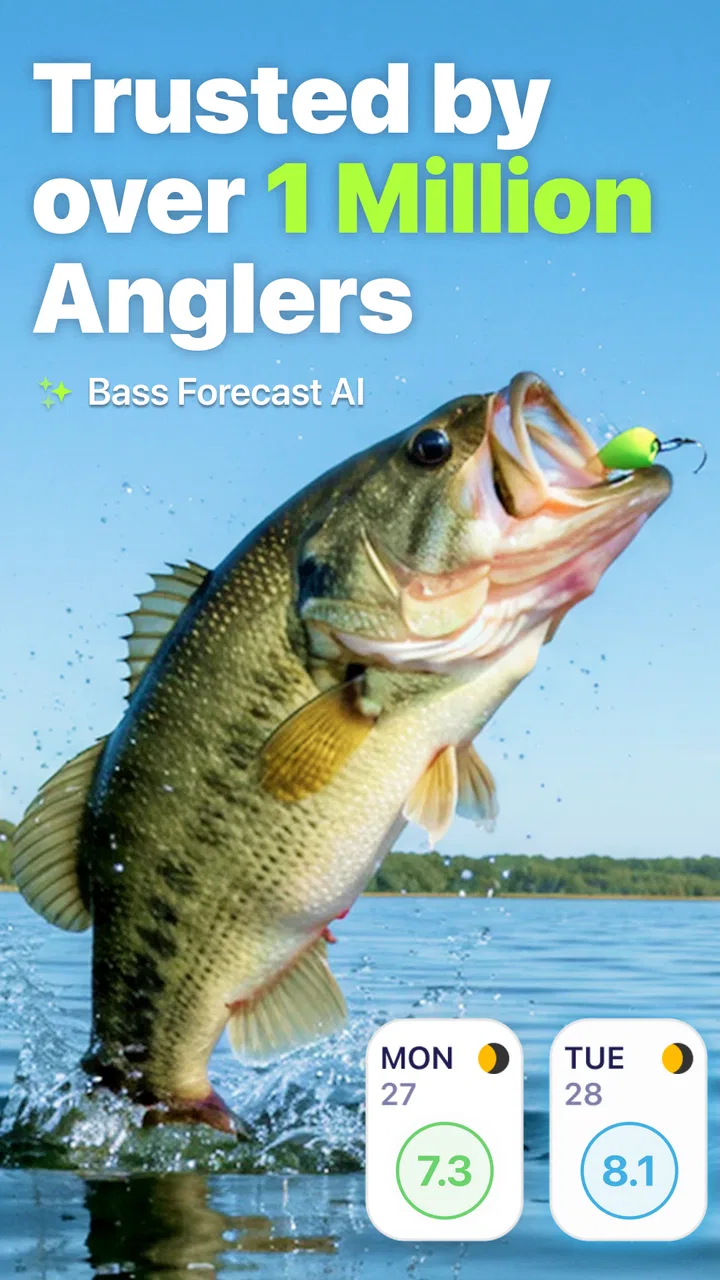
I downloaded BassForecast: Fishing Forecast expecting a quick way to decide whether a fishing trip was worth the drive, and that is still the best way to understand it. This is a sports app from BassForecast, LLC focused on bass fishing conditions rather than a general-purpose weather tool. I found it most useful when I already had a lake or river in mind and needed help turning a vague plan into a more deliberate choice of day, time, and lure.
The app is free to start, with optional in-app purchases ranging from $0.99 to $29.99 per item. It is rated for Everyone, runs on Android devices using at least version 6.0, and the current version is 6.3.1.8. Those details make it approachable for a wide range of anglers, although the usefulness of any forecast still depends on how carefully you interpret it and how closely your chosen water matches the available information.
From a vague fishing plan to a practical trip decision
I use this section to focus on the decision that happens before tackle is packed: turning a general wish to fish into a workable plan for a particular stretch of water. The useful shift is to treat the forecast as a way to narrow choices, then check whether the timing and travel actually fit my day. From there, I can look more closely at how the app feels during the moments when I rely on it most.
You May Also Like

 Blood Strike: 2.5 Anniversary
Blood Strike’s Loadouts Turn Every Drop Into a Tactical Gamble
A close look at Blood Strike’s custom loadouts: how fast access to signature weapons reshapes its battle royale rhythm, rewards preparation, and narrows the gap between fights.

 Pandora - Music & Podcasts
Pandora’s Music Is Easy to Start, but Harder to Recover
Pandora’s strength is its low-effort path from a seed to a station. Its weak spot is how much confidence it asks you to place in connection, setup, and quiet recovery.

 8 Ball Pool
 Is Built on Rivalries, Rematches, and Routine
A close look at the rivalries, rematches, shared routines, and unanswered safety questions that turn a quick pool match into a persistent mobile community.

 Samsung Music
’s Quiet Strength Is Playing What You Already Own
Its reach comes less from spectacle than from dependable access to a personal library. That simplicity is both the app’s strongest retention engine and its ceiling.

 AccuWeather: Weather Radar
AccuWeather Review: A Quick, Clear Forecast for Everyday Decisions
For everyday plans, the best forecast is the one you can understand quickly. AccuWeather makes rain timing, radar, and local conditions easy to act on, with a few trade-offs.

 Hill Climb Racing
Why Hill Climb Racing Still Turns Crashes Into One More Run
A tiny car, a bumpy hill and one more upgrade: Hill Climb Racing keeps resurfacing because its simple chaos makes every near-miss feel personal.
More From Our News Desk



Starting with the question that matters
Most fishing decisions begin with a simple question: should I go this morning, wait until tomorrow, or fish a different part of the day? A regular weather app can answer whether it will rain or how warm it may be, but that is only part of the problem. BassForecast tries to connect conditions with bass-fishing choices, so I can begin with the water I want to fish instead of sorting through unrelated weather details.
That distinction is important. I would not open this app expecting it to replace a chart, a navigation tool, or local knowledge. I use it as a planning layer. The forecast helps me think about timing and presentation before I leave home, while the lake itself still decides whether the plan works. Wind can change, boat traffic can alter a shallow area, and bass do not follow a screen perfectly.
The first useful habit is to choose the exact body of water rather than relying on a broad regional forecast. A general forecast may look promising across an entire county, yet the conditions on one reservoir can feel very different from those on a nearby river. Starting with the intended spot keeps the rest of the decision grounded in something I can actually act on.
Reading the forecast without treating it as a promise
Once I have a location in mind, I look at the suggested fishing windows and the lure guidance as a starting point. The appeal is not that the app magically identifies every fish. Its value is that it gives structure to choices I might otherwise make by habit. Instead of carrying a random collection of tackle and hoping the first pattern appears, I can begin with a smaller, more intentional plan.
For example, if I have only a few hours before work, the timing information helps me decide whether that short session is worth it. If the strongest window falls outside my available time, I can adjust expectations rather than arriving late and wondering why the bite feels slow. On a full-day trip, I can use the forecast to decide which periods deserve more focused effort and which periods are better suited to moving, scouting, or taking a break.
I also pay attention to the difference between a recommendation and a rule. A lure suggestion is useful when it gives me a first option, not when it prevents me from adapting. Water clarity, depth, cover, and recent fishing pressure can all outweigh a general recommendation. My practical approach is to bring the suggested presentation plus one faster and one slower alternative. That turns the forecast into a testing plan rather than a rigid instruction.
The handoff from phone screen to tackle box
This is where the app becomes more useful than a forecast I merely read and forget. I take the information from the screen and convert it into decisions about what goes in the boat or backpack. If the recommended approach suggests covering water, I prepare tackle that lets me search efficiently. If the conditions point me toward a more measured presentation, I make sure the relevant rods and terminal tackle are ready before I leave.
That preparation saves time in a realistic scenario. Imagine I have a Saturday morning available but need to be back by lunch. I can check the selected water the evening before, identify the most promising period, and organize a compact set of lures around that plan. In the morning, I am not spending the first half-hour opening boxes and debating where to begin. I can launch with a starting pattern, test it, and change it when the water gives me a reason.
The handoff is not only about equipment. I also use it to set a stopping point. If the forecast suggests a narrow window and my schedule is tight, I can decide whether the trip is worthwhile before paying for fuel or arranging transportation. That is a less glamorous benefit, but it is one of the strongest reasons to use a planning app: it helps prevent an unstructured trip from becoming an expensive guess.
Using location and timing together
A common mistake is to examine the best time and the best spot as separate answers. I get more from BassForecast when I connect them. A promising period is only useful if I am positioned to fish effectively during it. If I need to travel across a large lake, launch, and reach a distant area, the displayed window should influence when I leave rather than when I begin getting ready.
This is also a good reason to save a little mental space for the transition between forecast and reality. The app can help me choose a starting location, but it cannot account for every obstacle on the way there. A crowded ramp, difficult wind, or unsafe boat route may make a theoretically attractive area a poor practical choice. I would rather fish a reachable secondary area well than rush toward a forecast target and lose valuable time.
For shore anglers, the same idea applies differently. The best forecasted period may coincide with poor access, a long walk, or a bank that becomes difficult in bad weather. The app can improve the timing decision, but the user still has to match it with a location that is legal, safe, and realistically accessible. That is one of the clearest boundaries of the product.
What I do after the first cast
The result I want is not simply a green light to go fishing. I want a repeatable process for learning from the trip. I start with the recommended window and lure direction, then compare that plan with what I see: bait activity, water movement, cloud cover, wind direction, and how quickly fish respond. If the first choice fails, I change one factor at a time instead of abandoning the entire forecast.
This makes the app more valuable for an improving angler than for someone looking for certainty. A beginner can use it to avoid arriving without any idea where to begin. An experienced angler can use it as a second opinion before applying local knowledge. In both cases, the useful outcome is a clearer experiment: start here, try this, observe the response, and adjust.
One non-obvious advantage is that the forecast can help organize a post-trip review. I can remember what the app suggested, note what actually worked, and gradually learn where its guidance fits my local water. If a particular lake repeatedly fishes differently from the forecast, that does not automatically make the app useless; it tells me to give local observations more weight there. The strongest users will treat the app as part of a feedback loop.
Where the workflow breaks down
The biggest limitation is the natural uncertainty of fishing. No forecast can remove the effect of changing water levels, recent pressure, seasonal movement, or a bass population behaving differently from the broad pattern. If I need a guaranteed catch, this is the wrong kind of tool. It improves preparation, but it cannot turn a difficult day into a predictable one.
Another friction point is interpretation. Someone new to bass fishing may see lure or timing guidance and still wonder what to do when the first presentation fails. The app can narrow the starting choices, but it does not replace learning how to read a bank, select a depth, control retrieve speed, or recognize a subtle bite. I would pair it with hands-on practice rather than expecting the forecast to teach the entire sport.
There is also a practical trade-off between convenience and local detail. A specialized forecast is faster than assembling information from several weather screens, fishing reports, and personal notes. However, local anglers may already have a strong routine based on years of observation. For them, the app is more useful as a quick check before a trip than as the main source of truth. A detailed local report or direct conversation at a nearby tackle shop may offer context the forecast cannot provide.
Free access makes it easy to try without committing immediately, but the optional purchases matter if you want to use more of what the app offers. I would begin with the free experience on the waters I fish most often and judge whether it changes my decisions. That is a better test than buying first and hoping the recommendations fit every situation.
Who will get the most from it
I think this app is a strong fit for anglers who regularly debate whether conditions are worth a trip. It is especially practical for people with limited fishing time, because a forecast can help them choose a useful window instead of spending an entire day searching without a plan. It also suits newer bass anglers who know the basic equipment but feel overwhelmed by the number of possible lures and locations.
It can help traveling anglers too, provided they use it as preparation rather than a substitute for local research. When I fish unfamiliar water, having a structured starting point reduces the number of decisions I must make before the first cast. I still want a map, access information, and awareness of local rules, but the forecast gives the trip a tactical beginning.
On the other hand, I would skip it if my main need is navigation, detailed mapping, species coverage beyond bass, or a full fishing log. Those jobs belong to different categories of tools. I would also be cautious if I fish only one small local area and already have a highly developed routine. In that case, the app may confirm what I already know without adding enough value to change my behavior.
How it compares with ordinary alternatives
The usual alternative is to combine a general weather app with personal experience. That approach is flexible and often excellent for anglers who know how to translate wind, temperature, clouds, and pressure into a fishing plan. Its weakness is that the user must do all the interpretation. BassForecast is more direct because it puts the bass-fishing question at the center of the workflow.
Another alternative is relying on social media posts or informal fishing reports. Those can provide valuable local context, especially when someone has recently been on the same water. They can also be inconsistent, delayed, or too dependent on one person’s technique. I prefer the app for planning the initial strategy and local reports for checking what has happened recently. Neither source should be treated as complete by itself.
Compared with carrying a large tackle selection and changing randomly, the app encourages a more disciplined start. That does not guarantee better results, but it can make the trip easier to evaluate. If I change lures, locations, and retrieves all at once, I learn very little. If I use the forecast to establish a baseline and then make controlled changes, the outcome becomes more informative even on a day without a fish.
Everyday usability and confidence before leaving
The app’s appeal is strongest before the trip, when uncertainty is most expensive. I can check a planned water, consider the timing, and decide whether the outing fits my schedule. That is a more useful role than constantly staring at the forecast while fishing. Once I am on the water, I want to observe conditions directly and keep the phone protected, not let the screen dictate every cast.
I also appreciate that its audience is broad enough for casual use. The Everyone rating makes it suitable for families and younger anglers, although an adult should still handle the normal safety decisions around boats, weather, and water access. The app can support a fishing plan; it should never be used to justify going out in unsafe conditions.
Its adoption suggests that it has found an audience among mobile anglers: it has more than 100,000 installs, a 4.5 average from about 9,100 ratings, and roughly 3,200 written reviews. I read those figures as evidence of practical interest rather than proof that every forecast will suit every lake. The product has been available since June 30, 2016, which also gives it the feel of an established fishing utility rather than a brand-new experiment.
My final recommendation
After using it as a planning tool, I would recommend BassForecast: Fishing Forecast to bass anglers who want help choosing when to go, where to begin, and which lure direction to test first. Its best result is not a promise of fish; it is a cleaner handoff from forecast to preparation to observation. I can leave home with a reasoned plan instead of a pile of tackle and a hope that something happens.
The app is less compelling for anglers who need maps, navigation, broad species coverage, or highly detailed local reports. It also requires realistic expectations. Weather and fish behavior remain variable, and the recommendations become useful only when I combine them with what the water is actually showing me.
For me, the sensible approach is to start free, test it on familiar water, and compare its suggestions with my own results over several trips. If it consistently helps me use limited time better, optional purchases may be worth considering. If it merely repeats what I already know, I can return to my usual weather tools and local knowledge. That flexibility is exactly why I see this sports app as a helpful companion rather than something every angler must have.
My bottom line: use it to choose a starting plan, not to outsource your judgment. When the forecast, your schedule, and the water all point in the same direction, BassForecast can make the trip feel more deliberate before the first cast.
FAQs for BassForecast: Fishing Forecast
01What is BassForecast and how does it work?
BassForecast is a comprehensive fishing forecast app designed to help anglers optimize their fishing trips. It provides detailed weather forecasts, solunar data, and the best fishing times based on lunar phases and atmospheric conditions. By analyzing this data, it suggests the best days and times for fishing, helping users increase their chances of a successful catch.
02Is BassForecast suitable for all types of anglers?
Yes, BassForecast caters to both novice and experienced anglers. It offers insights that are valuable for anyone interested in fishing. Beginners can benefit from the app's easy-to-understand data and tips, while seasoned anglers can use the advanced features to refine their strategies and improve their catch rates.
03Does BassForecast require an internet connection to work?
While BassForecast offers some offline functionality, such as saved locations and settings, it primarily relies on an internet connection to provide real-time weather updates and forecasts. For the most accurate and up-to-date information, users should ensure they have a stable connection when using the app.
04Can BassForecast be used for types of fishing other than bass?
While BassForecast is optimized for bass fishing, its features can be beneficial for other types of fishing as well. The app's weather forecasts, solunar data, and fishing tips are applicable to various fishing scenarios, making it a useful tool for anglers targeting different species.
05Is there a cost associated with using BassForecast?
BassForecast offers a free version with basic features. However, for access to premium features such as extended forecasts, advanced tips, and additional customization options, users can opt for a subscription. The app's premium version is designed to provide more comprehensive data and tools for serious anglers.
Pros
- Accurate fish activity predictions.
- User-friendly interface for easy navigation.
- Customizable alerts for peak fishing times.
- Includes detailed weather forecasts.
- Covers a wide range of fishing locations.
Cons
- Requires a subscription for full features.
- Limited offline functionality.
- May consume battery quickly.
- Data updates can be slow at times.
- Not available in all regions.

BassForecast: Fishing Forecast
Gallery